"See, I have this day set you over the nations and over the kingdoms, to root out and to pull down, to destroy and to throw down, to build and to plant." (Jeremiah 1:10 NKJV)
In the latter part of this verse, there are six verbs and one sequence. And the sequence is not accidental. Four of the words are to remove. Two of them are to establish. God spends twice as much language on what must come out as on what goes in. Most leaders rush past the first four to reach the last two, but the order is the mandate. You cannot build on ground you have not cleared.
Before you read another verse, sit with the proportion. This is what the prophetic word actually does before it ever plants anything. This is the exegesis of the six words—what each one is doing, what it looks like when it operates, and why the order is mercy.
The Authority Behind the Words
Read the verse before it: "Then the Lord put forth His hand and touched my mouth, and the Lord said to me: 'Behold, I have put My words in your mouth'" (Jeremiah 1:9 NKJV). The authority to root out and to build was never Jeremiah's volume, education, or temperament. It was the word of the Lord in his mouth, set over nations and kingdoms. This is governmental language.
It also matters that Jeremiah wept over the very people his words confronted. He was not a detached critic dismantling from offense. He was a burdened messenger carrying God's heart and God's timing. So the six words are never permission to tear down from irritation, ambition, or personal wounds. They are a stewardship. Hold that as you walk through each one.
A man who has spent years diagnosing why complex systems fail learns one discipline above all others: do not treat the symptom you can see until you have traced it to the source you cannot. Replace the part that failed and you will be back at the same failure in a month. The same logic governs this verse. God refuses to address the visible without first reaching the root, and He gives us the precise order for doing it.
1. Uproot: Nathash
The first word is agricultural. Nathash (Strong's H5428) means to pull up by the roots or pluck a thing out of the place where it has fixed itself. It works beneath the surface in the root system that feeds everything visible above it. God does not begin with behavior. He begins underneath.
What most miss is that bad fruit is rarely the real problem; it is the report of a deeper root. Jesus carried this exact word into the New Covenant: "Every plant which My heavenly Father has not planted will be uprooted" (Matthew 15:13 NKJV). Longevity is not legitimacy. Some things in you, in your house, and in your sphere are old, established, familiar, and were never planted by God.
Consider a leader who cannot stop controlling. The visible fruit is micromanagement—a bottleneck where every decision must pass through him, resulting in good people who keep leaving. He works on the fruit. He reads about delegation. He resolves to trust his team. Within weeks the grip returns. The fruit was never the issue. Beneath it is a root planted decades earlier—a father who lost everything to a partner he trusted, and a son who quietly vowed he would never be that exposed. That vow is a root system. Until it is pulled up, every leadership technique he learns will be strangled by it. Natash goes after the vow, not the symptom. God uproots what is killing him so He can plant what will make him fruitful.
2. Tear Down: Nathats
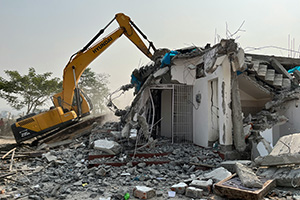 Once the root is exposed, the structure built on it must come down. Nathats(Strong's H5422) is the demolition word used for breaking down altars and pulling down walls (Deuteronomy 12:3). It moves from the hidden source to the visible architecture. Where nathash removes what feeds the system, nathats dismantles the system the root has built. (Photo via Unsplash)
This is where many leaders stop too early. They renounce the root but keep living inside the structure it constructed—the habits, the agreements, the relational patterns, the organizational chart designed around their fear.
Let's look at this word in operation. A young man named Gideon hid in a winepress, threshing wheat where no one could see because the land was overrun and he was afraid. The angel of the Lord found him there and called him a mighty man of valor. But before Gideon delivered a nation, God gave him a smaller, harder assignment: pull down the altar of Baal that his own father built, and cut down the wooden image beside it. He was to do this in his own household, on his own land, with his father's own bull. Gideon did it by night, afraid of his family and the men of the city, but he did it. He tore the structure down (Judges 6:25–32). And only after the altar in his father's house came down had the Spirit clothed him and the army gathered. The deliverer had to become a demolisher first.
The principle is plain. You inherited structures. Some of them your fathers built with sincerity. Sincerity does not make a structure holy. The reformer learns to ask not only what is the root, but what did the root build? Then he proceeds to take it down, even when it stands on family land.
3. Destroy: Abad
The third word goes further than demolition. Abad means to "perish," to "be lost," to "vanish" (Strong's H6). In the causative form used here, it means to cause a thing to perish—to bring it to an end so that it no longer functions. Tearing down leaves rubble, and rubble can be quietly rebuilt. Abad removes the thing from operation altogether.
God is not interested in merely damaging what opposes His government. He ends its jurisdiction. This is precisely the mission the Son of God came to carry out. "For this purpose the Son of God was manifested, that He might destroy the works of the devil" (1 John 3:8 NKJV). The Greek word John chooses for destroy is luó, and it means "to loose," "to dissolve," "to undo," and "to break" (Strong's G3089).
Christ did not come to negotiate with the works of the enemy or merely hold them at bay. He came to dissolve them, to undo them at the source, so they could no longer hold. Abad in Jeremiah's commission and luó in John's letter point to the same finished intention: not management, but undoing. So when the carrier brings an agreement to an end in his own sphere, he is not improvising. He is enforcing what the Son was manifested to accomplish.
This is the word that exposes the half-finished work. Think of the agreement that keeps coming back at reduced capacity—the appetite you manage instead of end, the toxic partnership you restructure instead of dissolve, the offense you forgive on Sunday and rehearse on Tuesday. You did not destroy it. You demolished its current form and left it able to regroup. Abad says the thing does not get to keep operating at a lower setting. It is brought to nothing.
A steward understands this in resources; a Believer must understand it in the spirit. There are agreements in a life and a line that operate until they are formally decommissioned—not weakened, but decommissioned. The engineer does not leave a faulty system powered down and reachable. He removes it from the architecture so it cannot be switched back on. That is abad. Whatever God brings to an end, He intends to stay ended.
4. Overthrow: Haras
The fourth word targets what is exalted. Haras means to "throw down" (Strong's H2040), to demolish what was raised up high—fortresses, walls, and thrones. Paul gives the New Testament echo with weapons "mighty in God for pulling down strongholds, casting down arguments and every high thing that exalts itself against the knowledge of God" (2 Corinthians 10:4–5 NKJV). Haras is the word for high places. It throws down what has set itself up above the rule of God.
 Notice the difference between this word and the three before it. Nathash works in the soil, nathats on the structure, abad on the function. Haras works on the throne—on whatever sits high.
A ministry begins in dependence and bears real fruit. Over years the fruit becomes a platform, and the platform becomes a name, and the name slowly climbs above correction. No one can speak into it anymore. The numbers are quoted like Scripture. The reputation must be protected at any cost. Something that began as a servant has enthroned itself. Haras is the word that brings that high thing down—not to destroy the ambassador, but to dethrone what the ambassador let rise. In the marketplace, it is the metric that has been crowned above the mission. In a nation, it is the ideology that has exalted itself against the knowledge of God and now legislates from a throne it was never given. (Photo via Unsplash)
Whatever exalts itself eventually has to be thrown down. The only mercy is whether it comes down by His hand in this season or under its own weight in the next.
Four words now stand together: root, structure, function, throne. God clears the ground completely—beneath, around, within, and above—before He builds a single thing on it.
5. Build: Banah
Now the language turns from removal to establishment. Banah is "to build"—houses, cities, the temple (Strong's H1129). But in Hebrew, to "build a house" also means to establish a family, a dynasty, a lasting line. When David wanted to build God a house, God answered by promising to build David a house that would not end (2 Samuel 7). The same verb covered both the stone and the lineage. Banah is generational by nature.
This reframes what building even is. The leader, fixated on his own platform, builds for a season. The builder who understands banah builds for a line he will not live to see. He raises leaders instead of audiences. He writes down what he learned so the carriers after him do not start from zero. He constructs systems strong enough to run without him, because a house that collapses when its builder leaves was never a house; it was scaffolding around one man's gift.
Ask the question that separates the two: Am I building something that requires me, or something that can be inherited? Banah always answers in favor of the heirs.
6. Plant: Nata
The final word answers the first. Nata means "to plant" (Strong's H5193)—to set something into the ground for long-term fruitfulness. God Himself planted a garden in Eden (Genesis 2:8). It is the most patient word in the verse. You plant what you intend to harvest across seasons, not days, sending roots down long before any fruit appears above the soil.
Planting cannot be rushed, and it cannot be faked. A man who plants a vineyard knows he will tend it for years before he tastes it and that some of the wine will be poured for people he will never meet. That is what it is to pour into the next generation of leaders—slow, hidden, root-first work, with the harvest set in a future you are stewarding for someone else. The son you disciple, the daughter you commission, the young carrier you refuse to give up on—all of that is nata. You are not planting for your own table.
And here is the design most readers walk straight past. The commission opens with uprooting and closes with planting, the same agricultural domain bracketing the entire mandate. Nathash and nata are bookends. God pulls up what He never planted precisely so He can plant what will bear fruit for generations. The verse begins and ends in the soil. Everything between is the work of getting the ground ready.
The Order Is the Mercy
 Step back and look at the whole sequence. Four words to remove, two to establish. A leader who loves to build reads that ratio as inefficiency. He wants to skip to banah and nata, because that is where the satisfaction lives. But the proportion is not inefficiency. It is mercy. (Photo via Unsplash)
God gives four words to clearing, because He knows the truth that every builder eventually learns the hard way: what you fail to remove will contest what you plant. Build a house on an unaddressed root and the foundation will crack along the old fault line. Plant good seed in unbroken ground and the existing root system will choke it before it ever fruits. The four-fold removal is not God's reluctance to bless you. It is His commitment to making the blessing last.
There is one more pattern in the order. Removal moves outward and downward to upward—root, structure, function, throne. Establishment moves the opposite direction. First you build the house, then you plant the field around it. God secures the structure that will hold the family before He sets in the slow-growing things that will feed it. He is not careless about sequence in either direction. The carrier who learns the order stops wasting years building on ground that was never cleared.
The Two-Handed Mandate
The commission was never Jeremiah's alone. It is the pattern by which God reforms anything—a nation, a company, a household, a life—through a yielded voice carrying His word. And in the new covenant, that same governmental authority rests on every carrier who carries that word. Set over the nations and the kingdoms is not a line reserved for the prophets of old. In your sphere, over the thing God has actually assigned to you, you have been positioned to root out and to build. Which means the six words are not a study to admire; they are a mandate to execute. You have been handed both an ax and a seed.
Watch how the New and Old Testaments put both into your hands. John the Baptist carried the first hand of the mandate—the ax laid to the root, the voice crying in the wilderness to prepare the way, the confronter of every tree that did not bear good fruit (Matthew 3:10). His was the tearing-down grace: expose, repent, clear the ground. Joseph carried the second hand of the mandate—the wisdom to read the times, build the storehouses, steward the harvest, and preserve a generation through famine (Genesis 41). His was the building grace: store, manage, plant, sustain.
A reformer who carries only the ax becomes harsh, reactionary, and critical, swinging at roots with no field to plant. A builder who carries only the storehouse constructs beautiful systems on corrupted foundations that the next generation will have to tear down again. The mandate of Jeremiah 1:10 refuses to let you specialize. You are called to both hands: the courage to confront what is false and the wisdom to build what is fruitful. You are meant to be the voice that prepares the way and the steward who preserves the future.
Take up both, builder. The four words and the two words are one assignment, and they were always meant to be carried together.
Walking the Sequence in Your Sphere
The exegesis is not finished until it reaches your hands. The six words are a process, not a vocabulary list. Walk them in order.
Trace the fruit to its root before you touch anything. Name the recurring fruit you have been fighting at the surface—the division, the burnout, the control, the drift. Then ask the engineer's question: What is the actual source feeding this, not the part that failed last? Do not move to demolition until you can name the root. This is nathash, and it cannot be skipped.
Tear down the structure the root built, even on family land. Once the root is named, find the architecture it constructed—the habit, the agreement, the system, the altar your fathers raised with sincerity. Pull it down. Sincerity does not sanctify a structure. This is nathats, and it usually costs something relational.
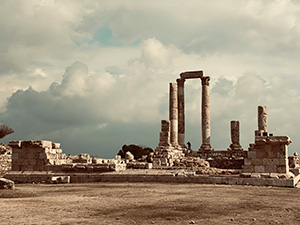 End it, do not manage it. Refuse the half-measure that leaves the thing powered down and reachable. Whatever God is bringing to an end, decommission it formally and completely so it cannot be switched back on. This is abad. Renounce it specifically, apply the blood over the sphere, and close the jurisdiction. (Photo via Unsplash)
Throw down what has been enthroned. Identify the high thing—the platform, the metric, the reputation, the idol—that has climbed above the rule of God in your life or your house, and dethrone it before it has to be thrown down for you. This is haras.
Then build a house, and plant a field for the ones who come after you. Only now do you reach the constructive words. Build what can be inherited rather than what requires you. Plant the slow-growing things—the leaders, the disciples, the children—whose fruit you may never taste. This is banah and nata, and it is the whole point of the clearing.
The Fulfillment of the Six-Fold Mandate
Ultimately, Jeremiah's six-fold mandate finds its fulfillment in Jesus Christ. At the Cross, He uprooted the power of sin. He tore down the dividing wall between God and man. He destroyed the works of the devil. He overthrew principalities and powers, triumphing over them openly. Yet He did not stop there.
Through His death and resurrection, He began building a new covenant, a new temple made of living stones, and a new humanity reconciled to God. He planted a Kingdom that cannot be shaken and a people destined to bear fruit that remains.
This is the pattern of redemption itself. God removes in order to restore. He tears down in order to rebuild. He confronts what is false in order to establish what is true. He exposes what is temporary in order to reveal what is eternal.
If you find yourself in a season where God is uprooting, exposing, dismantling, or overturning things you once depended upon, do not mistake His activity for rejection. The God who clears the ground is the same God who plants the seed. The God who tears down unhealthy foundations is the same God who builds lasting houses.
The four words of removal are not the destination. The two words of establishment reveal His ultimate intention. His goal has always been restoration. His goal has always been fruitfulness. His goal has always been inheritance. His goal has always been a people who reflect His glory and carry His Kingdom into every sphere of life.
The Lord who commissioned Jeremiah is still commissioning men and women today. He is looking for those who will carry both dimensions of His heart: the courage to confront what must be removed and the wisdom to establish what must remain.
May we become people who faithfully steward both the ax and the seed, participating with God as He restores ancient ruins, rebuilds desolate places, and plants oaks of righteousness for the display of His glory. For in the end, God's purpose is not merely to remove what is broken, but to establish what will endure for generations.
Whatever you do, don't miss another ELIJAH LIST email! Subscribe at this link: elijahlist.com/subscribe.
Will Meier
Awakening Destiny Global
Email: info@awakeningdestiny.global
Website: www.awakeningdestiny.global
Will and Donna Meier are dynamic leaders at Awakening Destiny Global, passionately dedicated to awakening Believers and nations to their God-given destinies. Their mission is to restore and catalyze a global movement of spiritual revival and transformation. Will, a Kingdom entrepreneur, speaker, and leadership coach, combines decades of experience in a Fortune 50 aerospace company with his spiritual leadership. He is the author of 'Leaders for Life—Creating Champions through the NOW Leadership Process,' focusing on integrating Kingdom principles into marketplace leadership. Donna is actively involved in their community and was recently elected to the local board of education, where she advocates for children and aims to drive positive change. Their shared commitment to spiritual and community leadership makes them an influential apostolic and prophetic team across both spiritual and secular spheres. Will and Donna have two sons, live in Connecticut, and enjoy outdoor adventures and travel.
To receive more words like this in YOUR inbox, subscribe FREE to the Elijah List at this link: elijahlist.com/subscribe.

Thank you for making the always-free "ElijahStreams" possible. To partner with us, click here.
Your donations truly help us keep these emails free for you. Donate at:
Find us on Facebook click here