Ed Grifenhagen: Kapporeth - Where Mercy Meets Holiness
Apr 4, 2026
From the Desk of Steve Shultz:
I recently came across this article by Ed Grifenhagen on Brian Simmons' website, The Passion Translation. It really grabbed me, and I know it's going to speak to you too! Just read these powerful words from Ed: "... Paul says something that should stop you in your tracks, 'Jesus' God-given destiny was to be the sacrifice to take away sins, and now He is our mercy seat because of His death on the cross' (Romans 3:25 TPT). "Read that again slowly: 'now He is our mercy seat.' Paul takes the mercy seat concept and puts it on Jesus. The place becomes a Person. The meeting point becomes flesh and blood. What was once neatly tucked behind a curtain is now revealed in Christ... "On this side of the cross, reconciliation is a finished work you receive rather than a ritual you repeat over and over. It means the 'where' of mercy isn't a room in a tabernacle or a temple, accessed once a year by one anxious man with trembling hands. Now the mercy seat has a name: Jesus! Now that's GOOD NEWS! Read on to learn more about this profound revelation and invitation to the Mercy Seat! Steve Shultz, Founder and Host The Mercy Seat That Became a Person "Make a lid for the ark—a mercy seat of pure gold." (Exodus 25:17 TPT) There are words in Scripture that simply steady you. When everything seems like it's spinning, they're foundational. They name your burdens and then point to the only place where your junk can truly be dealt with—not with denial or "religious" busyness, not with an "I'll do better" philosophy, but by surrendering to something stronger. One of those words is kapporeth, meaning "mercy seat." The first thing to understand is this: the mercy seat wasn't some decorative lid picked up at a yard sale. It wasn't religious furniture meant to impress people. It was a holy meeting place where Israel learned something terrifying and beautiful at the same time: God is infinitely holy... and God makes a way. A gold-covered place, smack in the middle of the impossible. Exodus 25 provided God's people with the tabernacle's blueprints, and right at the center of it all sits the ark of the covenant in the Holy of Holies. Covering that ark was the solid gold kapporeth—the mercy seat—where presence of YAHWEH dwelt. The Lord told Moses, "Make a lid for the ark—a mercy seat of pure gold." Simple instruction, right? Maybe, until you remember what it represented. In ancient Jewish culture, the mercy seat was understood to be the place where God "hung out" with His people. This was neither theoretical nor symbolic. It was a sacred reality. There's a healthy tension that reverberates throughout all of Scripture: How can a holy God dwell among an unholy people without consuming them? How can the Creator be near sinners without justice doing what justice does? The mercy seat was God's answer—at least for a season. The Day of Atonement: When Mercy Had a Bloodline Once a year, on Yom Kippur, the Day of Atonement, the high priest entered the Holy of Holies: not casually, not confidently, not like a man strolling into his living room to watch a football game. This was hand-quivering work. He came with goat's blood, and sprinkled it across the mercy seat to satisfy the righteous demands of God and to make atonement for the sins of Israel... until the next year. "Until next year," that little tidbit matters. The mercy seat was a real meeting place, but it also carried an ache inside it—the ache of repetition, the ache of over and over and over, the ache of knowing that sin doesn't disappear just because you regret it or try harder. Every year was a reminder: reconciliation is needed, desperately needed... it always is. Holiness is real. Sin is costly. And mercy is not cheap.
How? Why? Because blood splattered on gold wasn't the final story. (Photo via Wikimedia Commons) The Stunning Twist: "Kapporeth" Becomes a Person Then you turn the pages to the New Testament, and Paul says something that should stop you in your tracks, "Jesus' God-given destiny was to be the sacrifice to take away sins, and now He is our mercy seat because of His death on the cross" (Romans 3:25 TPT). Read that again slowly: "now He is our mercy seat." Paul takes the mercy seat concept and puts it on Jesus. The place becomes a Person. The meeting point becomes flesh and blood. What was once neatly tucked behind a curtain is now revealed in Christ. Don't miss what this forces us to hold together: the gravity of our sin and the price paid to redeem and reconcile us. The mercy seat was never God pretending sin didn't matter. It was God declaring that sin mattered so much it required atonement, genuine atonement. And Jesus becoming our mercy seat means the cost was not symbolic, not metaphorical, not hyperbole—it was personal. The cross wasn't a religious illustration or parable. It was the real price of real redemption. On this side of the cross, reconciliation is a finished work you receive rather than a ritual you repeat over and over. It means the "where" of mercy isn't a room in a tabernacle or a temple, accessed once a year by one anxious man with trembling hands. Now the mercy seat has a name: Jesus! What Your Heart Has Been Trying to Fix on Its Own Most of us don't wake up thinking, "Today I should ponder the architecture of the tabernacle." What we do feel is the pain that the mercy seat was designed to heal: We try to nurse that pain with a hundred things that will never work. They weren't designed to. We distract ourselves. We work harder. We compare, minimize, and we beat ourselves up. We turn shame into "spirituality" and call it humility. But the message of the mercy seat is radically different. It doesn't tell you to pretend sin isn't serious. It tells you God takes sin very seriously, so seriously that He sacrificed His Son to redeem you. That's why Romans 3:25 is, arguably, the heartbeat of the Gospel. Jesus is not merely an example of love. He is the place where love and justice crash together without compromise. He is God's holy solution to our unholy reality. The mercy seat is where God can be perfectly righteous and extravagantly merciful and where you can stop negotiating and start believing. The Curtain Isn't the Point Anymore
You don't visit mercy occasionally. You're heavenly Father invites you to build your life on it. That's why Paul's language matters: "now He is our mercy seat." Present tense—current reality—not merely historical fact. How to Respond: Acknowledge, Accept, Live There's a difference between knowing something is true and living like it's true. You can believe Jesus died for sins and still carry yourself like you're one failure away from getting kicked to the curb. You can sing about grace and still flog and scourge yourself in private. You can preach forgiveness and still feel permanently disqualified. So, here's the gentle but direct invitation of kapporeth: A Quiet Way to Pray This Into Your Week If you're carrying hidden shame or guilt, try praying these two verses together, letting Exodus identify the holy reality, and letting Romans declare the finished reality: "You shall make a mercy seat of pure gold." (Exodus 25:17 TPT) "Now He is our mercy seat because of His death on the cross." (Romans 3:25 TPT) Take a minute and speak the truth in plain language: "Jesus, I'm done trying to do it myself, done trying to earn what You already paid for. Jesus, I surrender, and I come to You for mercy." Then, close your eyes and chill for just a minute: no striving, just receiving. Because the mercy seat isn't the spot where you impress God. It's the place where God restores you. Prayer Jesus, thank You for being my mercy seat. You're the point where holiness and mercy meet without compromise. Today's the day that I acknowledge the weight of my sin and stop pretending it's small. Thank You for paying the giant price You paid to redeem and reconcile me. Today, I accept Your finished work with incredible gratitude. Teach me to live from reconciliation, not for it. Lord, let obedience always be my response, rather than my payment. Thank You for Your unstoppable audacious grace. Amen. (Used by Permission via The Passion Translation.)
Whatever you do, don't miss another ELIJAH LIST email! Subscribe at this link: elijahlist.com/subscribe.
Ed Grifenhagen Ed Grifenhagen is a Pastor, writer, and Set Shepherd movie chaplain. Ed Grifenhagen grew up in a passionately Jewish home in Georgia. He radically surrendered his life to Christ at thirty-five and has been a pastor since 2018. Pastor Ed Grifenhagen grew up in a devout Jewish home before Jesus transformed his life. He and his wife Susan have two adult sons and several grandchildren. In Ed's book, 365 Hebrew Words Every Christian Should Know, he extracts hundreds of Jesus-focused truths from Hebrew and ancient Jewish practices. Deepen your relationship with Jesus as you explore how Hebrew reveals the beauty of the Gospel.
To receive more words like this in YOUR inbox, subscribe FREE to the Elijah List at this link: elijahlist.com/subscribe.
Thank you for making the always-free "ElijahStreams" possible. To partner with us, click here. Your donations truly help us keep these emails free for you. Donate at: Find us on:
|


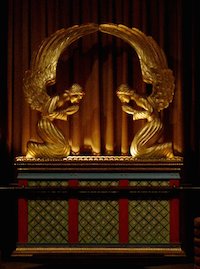 The mercy seat in the Holy of Holies was where reconciliation between sinful humanity and a holy God occurred—where the breach was covered and the covenant relationship declared, "Proceed!" But the whole system was pointing forward. It was a shadow, a signpost, a marker.
 In the tabernacle, the mercy seat was hidden behind a fifteen-foot veil (curtain) of fine linen woven with blue, purple, and scarlet yarn, embroidered with cherubim. Access was restricted. The whole scene communicated holiness and distance. But in Christ, the direction of the story changes. God doesn't say, "Try harder to reach Me." He says, "I came to you." The mercy seat isn't hiding behind a curtain anymore; it's freely offered as a refuge. And not a refuge from God, but a refuge in God. Yes, Jesus is the reason you are forgiven. But maybe even more than that, Jesus is the place you get to live from now on. (Photo via Rawpixel)